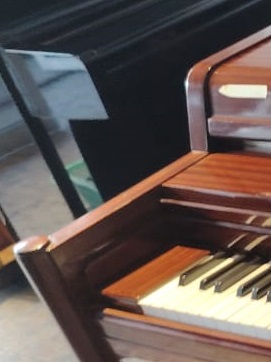
*** The Action System: The heart of the piano
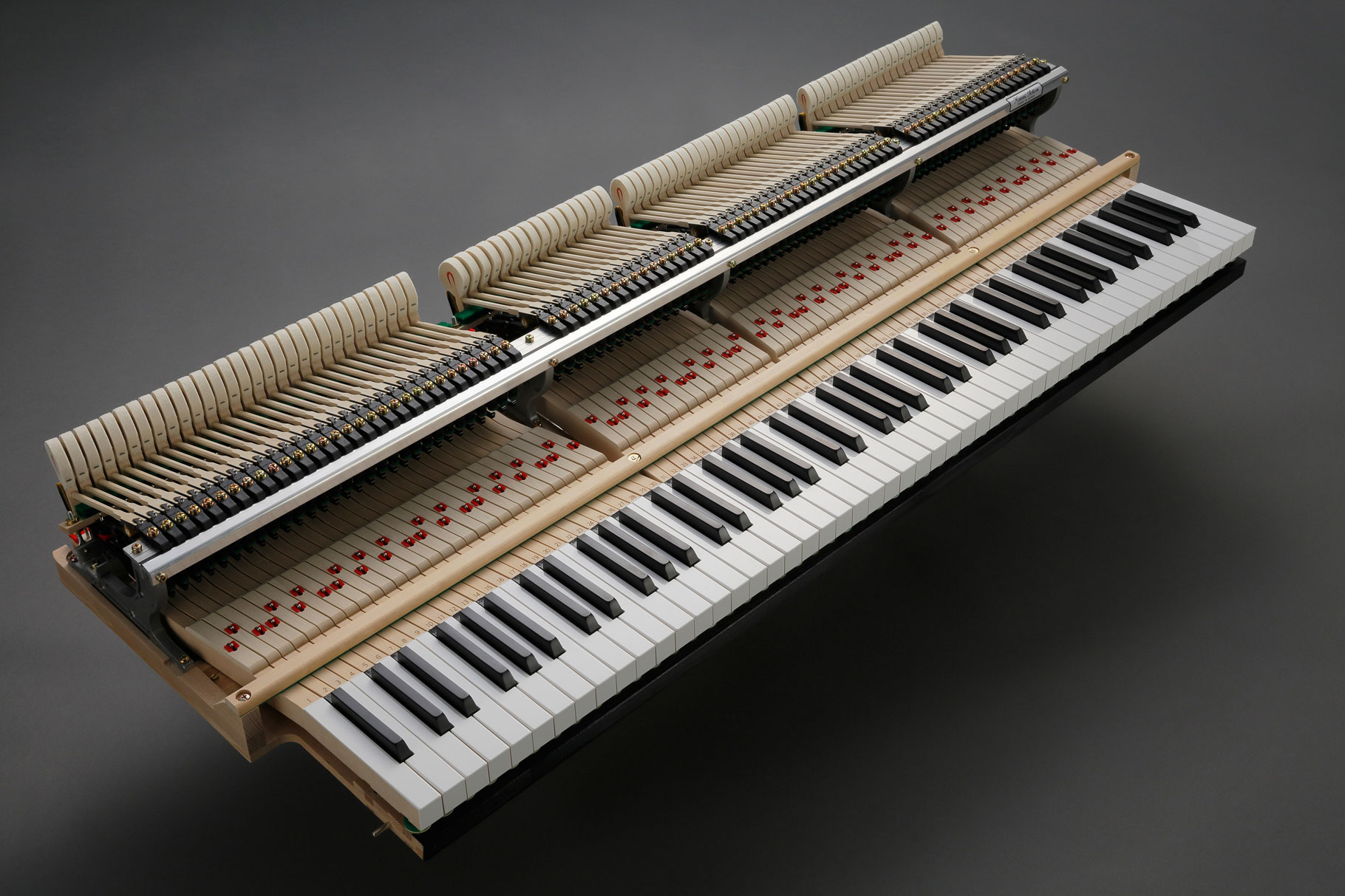
The action—the mechanism that allows the hammer to strike the strings—is the most complex part of a piano.
We remove the entire action and place it on a specialized bench for inspection:
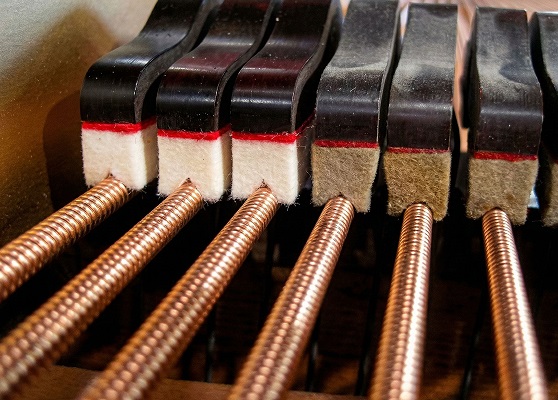
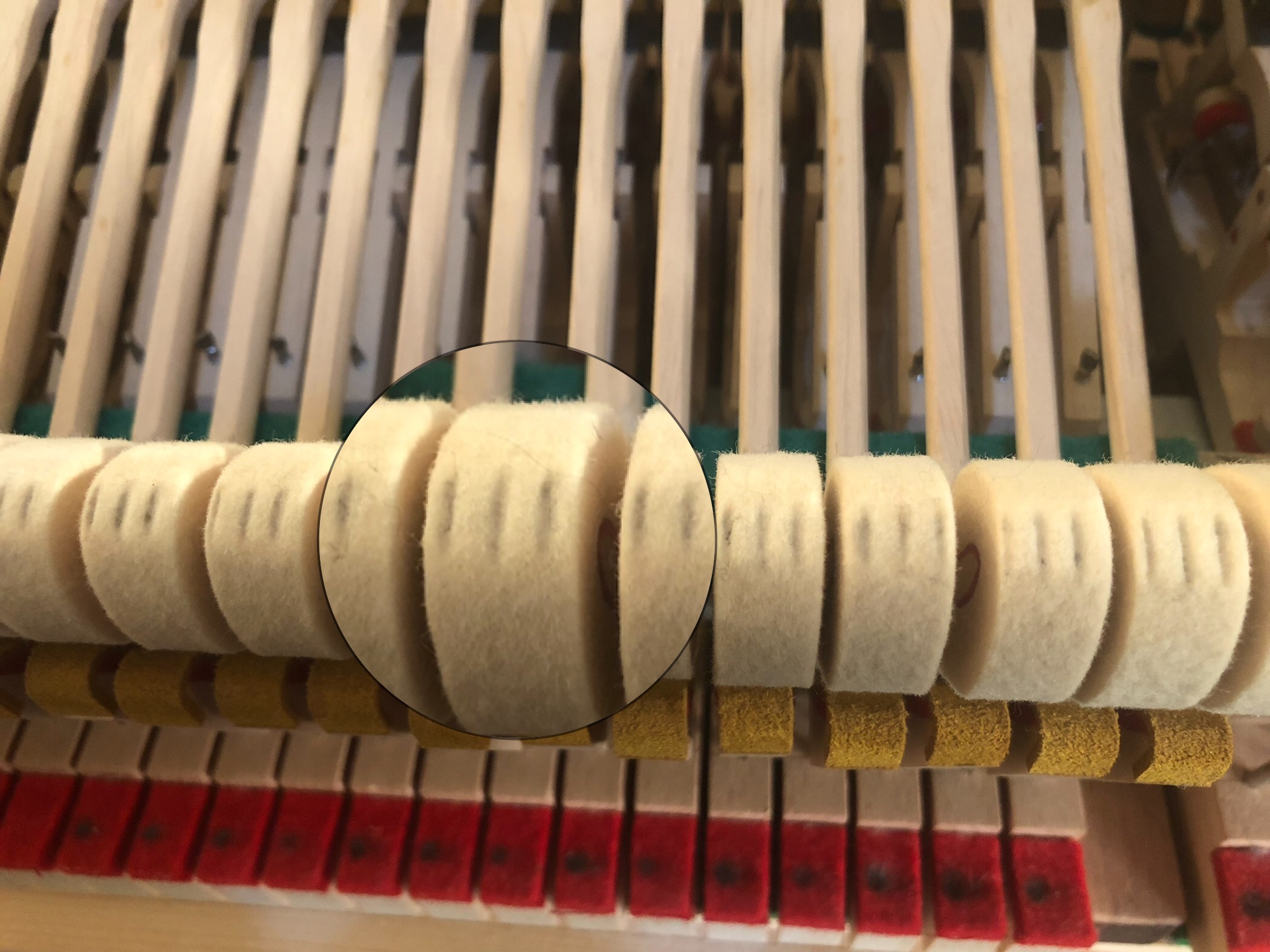
Hammers: dents? worn felt? hardened or softened?
We reshape them with sanding tools or replace the felt entirely for a uniform tone.
Jack, repetition lever, springs: we test the response of each one to prevent sticking or sluggish keys.
We adjust let-off and drop—
even a 0.1 mm difference changes the feel of the keys.
After adjustments, we play the piano ourselves.
Is the touch responsive? Does each key bounce back naturally?
This tells us whether the piano feels “alive.”
*** Damper: The balance between motion and silence
The damper’s job is to stop a string from vibrating the moment you release a key.
If it’s slow, the sound lingers; if it’s too hard, the sound cuts off abruptly.
The first thing we check is the responsiveness of every single damper—
it must be sensitive, even, and quiet.
We test them one key at a time, dozens of times each.
Sometimes a damper may be angled a few millimeters off, causing incomplete contact with the string.
We adjust the felt carefully so it fits perfectly.
If necessary, we replace the entire felt set and align it precisely using professional adhesives and templates.
This may sound excessive, but clean damping is crucial.
When a piano sounds “muddy,” the damper system is often the culprit.
We ensure that even the lightest touch will stop cleanly and decisively.
*** Hammer: Every Strike Is a Heartbeat
The hammer is the piano’s “muscle for sound.”
Every hammer’s force, angle, and hardness affects the tone.
We check all hammers to ensure the felts are even and free from wear, dents, or aging.
Some pianos may look new externally, but their hammers have long been “flattened,” producing muffled or weak sound.
We use specialized voicing needles to loosen the felt layer on the hammer surface, restoring its original elasticity.
This process is like giving a massage—it requires experience and sensitivity; too shallow has no effect, too deep can damage the structure.
After adjustment, we strike each key to test and ensure that the hammer’s point of contact is precise.
From high to low notes, the sound must be balanced, with no abruptness or collapse.
If individual hammers respond inconsistently, we micro-adjust the hammer shanks to ensure perfect alignment of striking angle and distance.
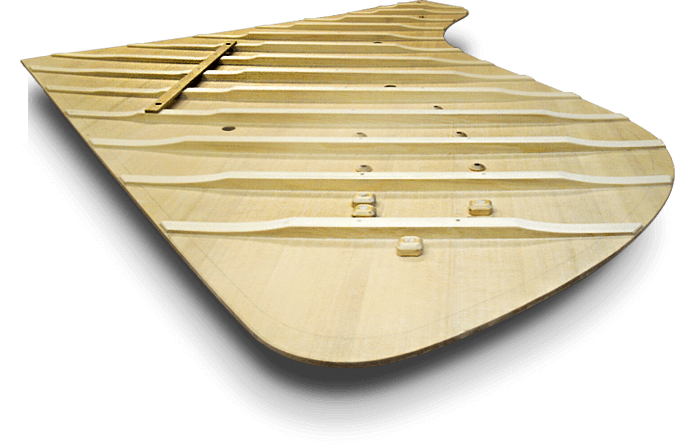
*** Soundboard: The Soul That Lets the Piano “Breathe”
The soundboard is like the piano’s lungs—it determines resonance and sustain.
We carefully check for cracks, splits, warping, or minor deformations caused by climate.
These issues may be invisible to the eye, but if present, they disrupt the sound’s resonance.
We inspect using side lighting and a resonance-testing mallet, judging the soundboard’s health by the tones it produces.
For minor cracks, we perform “invisible repairs” using specialized wood inserts, maintaining tension and sealing.
We also check the ribs, the “rib bones” of the soundboard that support its curvature and transmit vibrations.
Any looseness is reinforced with special wood glue.
Once stable, we gently strike the strings to test resonance, ensuring the soundboard can “breathe” naturally—the sound is airy, neither muffled nor hollow.
*** Keyboard & Keys: The Art of Touch
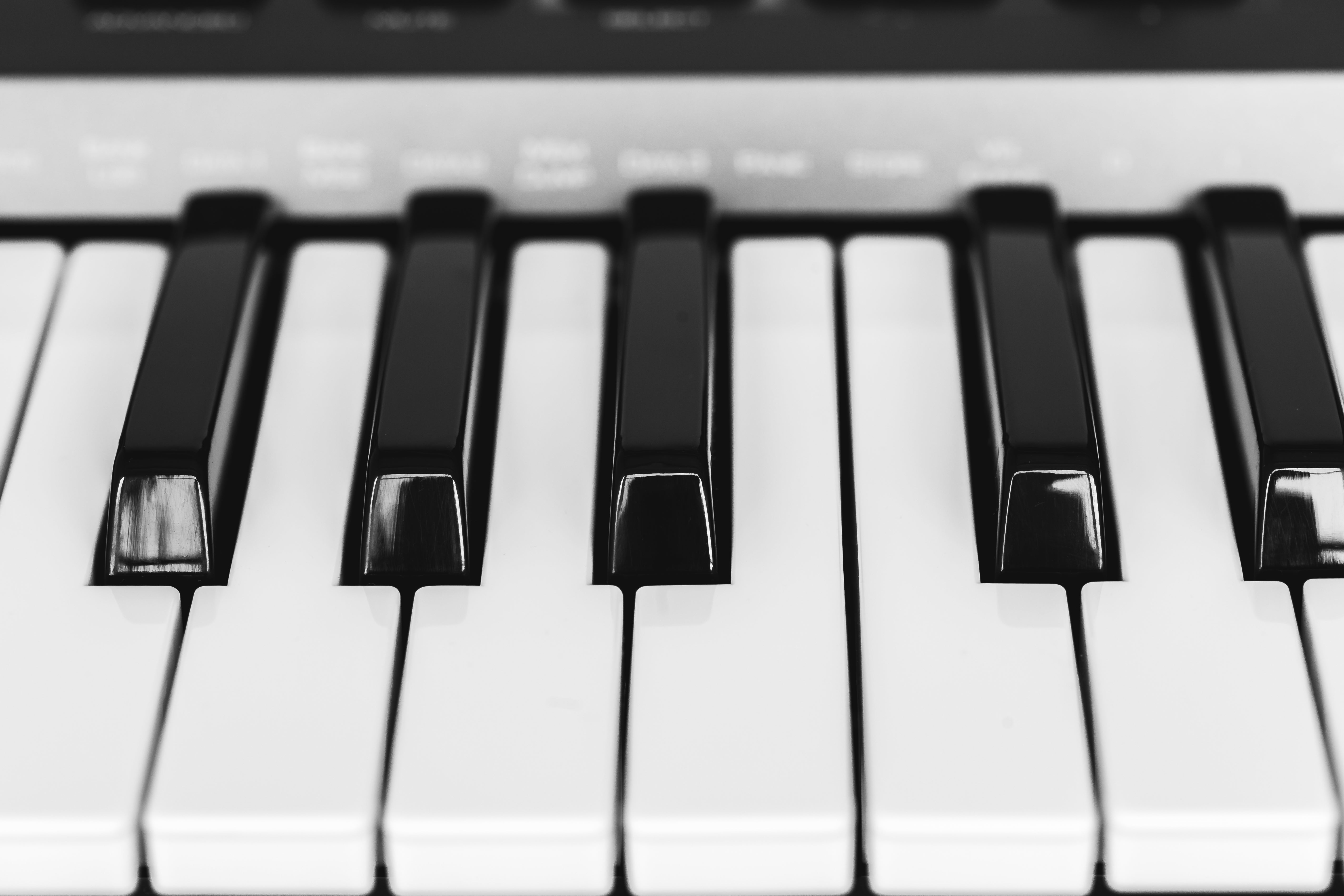
The keyboard is the connection between the pianist and the piano.
Every sensation—weight, rebound, resistance—is hidden in the balance of each key.
We remove the keyboard to clean every balance pin and front pin, then check each key’s balance.
Some keys may tilt or rebound slowly due to humidity, dust, or aging.
We adjust the felt beneath the keys and lubricate the pins to ensure consistent key pressure—typically controlled between 48g–52g.
Next, we measure key depth—the distance from the key’s highest point to fully depressed.
Every piano has a standard range, and we measure to 0.1mm precision.
The feel should be “light but stable, firm but not heavy,”
so whether playing Beethoven or Joe Hisaishi, your fingers move with confidence and ease.
*** Tuning Pins: A Millimeter of Stability Determines the Whole Piano
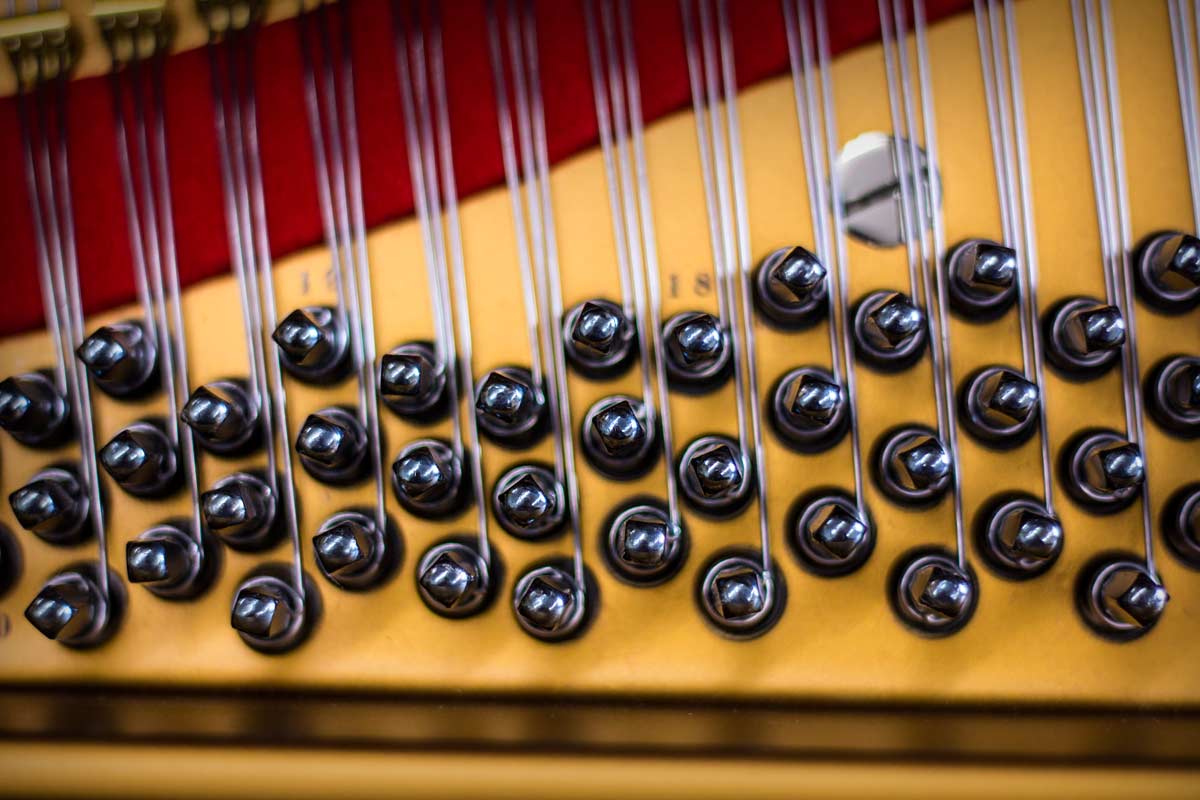
Tuning pins are one of the most overlooked but crucial parts of a piano.
They act as the joints of the instrument, holding all string tension.
If a pin is loose, no matter how much you tune, the pitch won’t hold.
During restoration, we test each tuning pin’s tightness using specialized torque tools, feeling for the ideal balance of “tight where it should be, loose where it should be.”
Pins and pinholes that have loosened over time or due to humidity are never patched superficially;
we replace or reinforce them with thickened PinBlock wood, ensuring every pin bites the board firmly.
We also test pitch stability—after tuning, we leave the piano for several days, then retest.
If the pitch remains within the standard range, it passes.
For us, a piano’s “good tone” is not only a momentary beauty but a long-lasting balance.
*** Strings: Confirming Every String Is “Healthy”
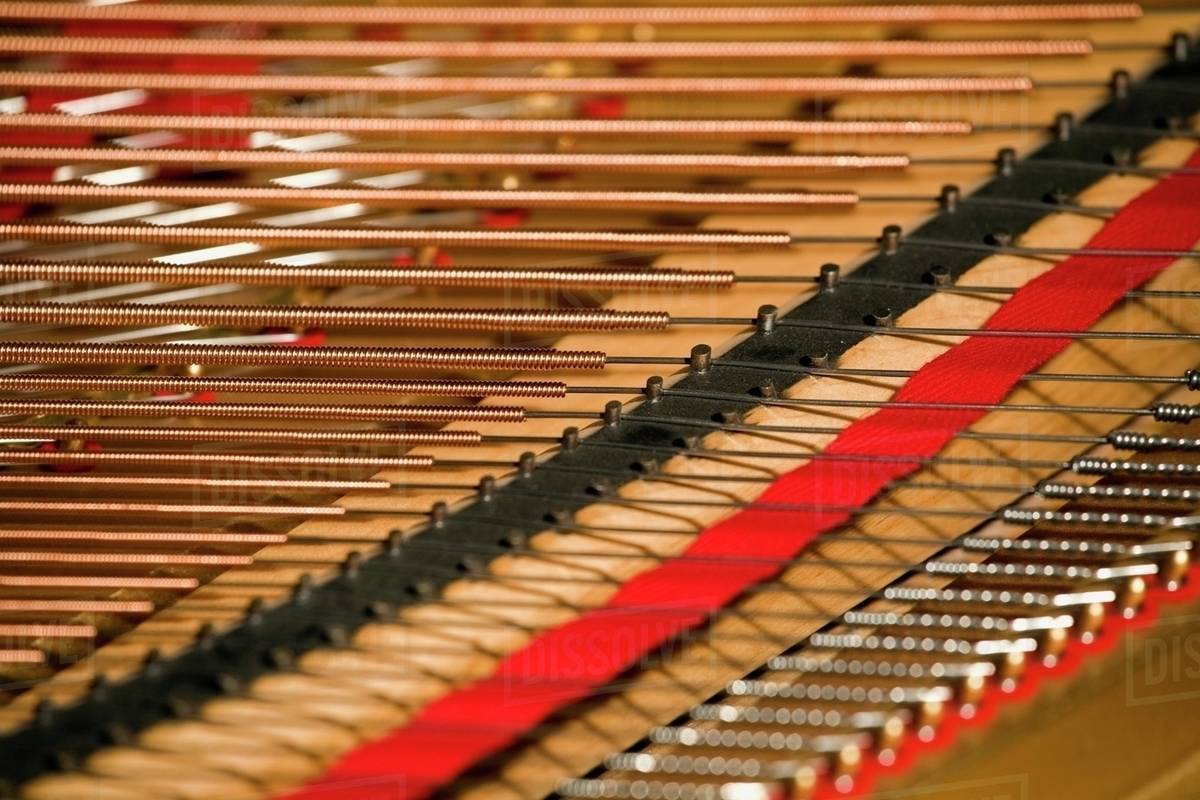
We wipe, remove rust, and replace strings when necessary.
Old strings often have oxidation, producing a dull sound easily distinguishable by ear.
New strings are installed and gradually tensioned to stabilize before tuning—usually over several rounds, because new or restored strings “settle” gradually.
We also lightly strike the strings to test resonance, ensuring balance across the string length, especially in the bass section.
Good bass should be “full” but not “muddy”; this segment is repeatedly tested for precision.
*** Bridge: Carrying Vibrations to the Soul of the Instrument
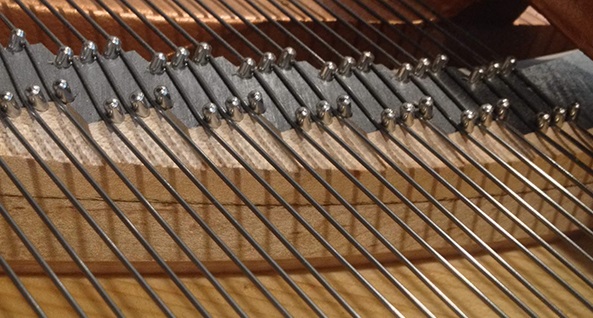
The bridge is literally the “bridge” between the strings and the soundboard.
Its job is to deliver the vibration energy of the strings precisely to the soundboard.
If the bridge develops cracks, loses adhesion, or if the bridge pins become loose,
the sound immediately becomes weak and hollow.
We inspect the bridge using a combination of “eyes + ears + hands.”
First, we shine a light to check for fine cracks, then tap lightly to test the sound.
A healthy bridge produces a crisp tone, while a problematic one sounds slightly muffled.
If cracks are found, we use a “layered repair” method—
injecting high-density wood glue from the inside, then adding thin wood veneers on the outside
to restore structural tightness while keeping the appearance clean.
Sometimes the bridge-pin holes on older pianos become loose from many string changes.
In those cases, we use custom steel pins and alignment plates to readjust them,
ensuring the string angles and pressure are consistent.
This tiny angle difference actually determines the instrument’s resonance path.
We want every string’s energy to be “fully transmitted.”
*** Fallboard: More Than Protection—It’s a Matter of Touch
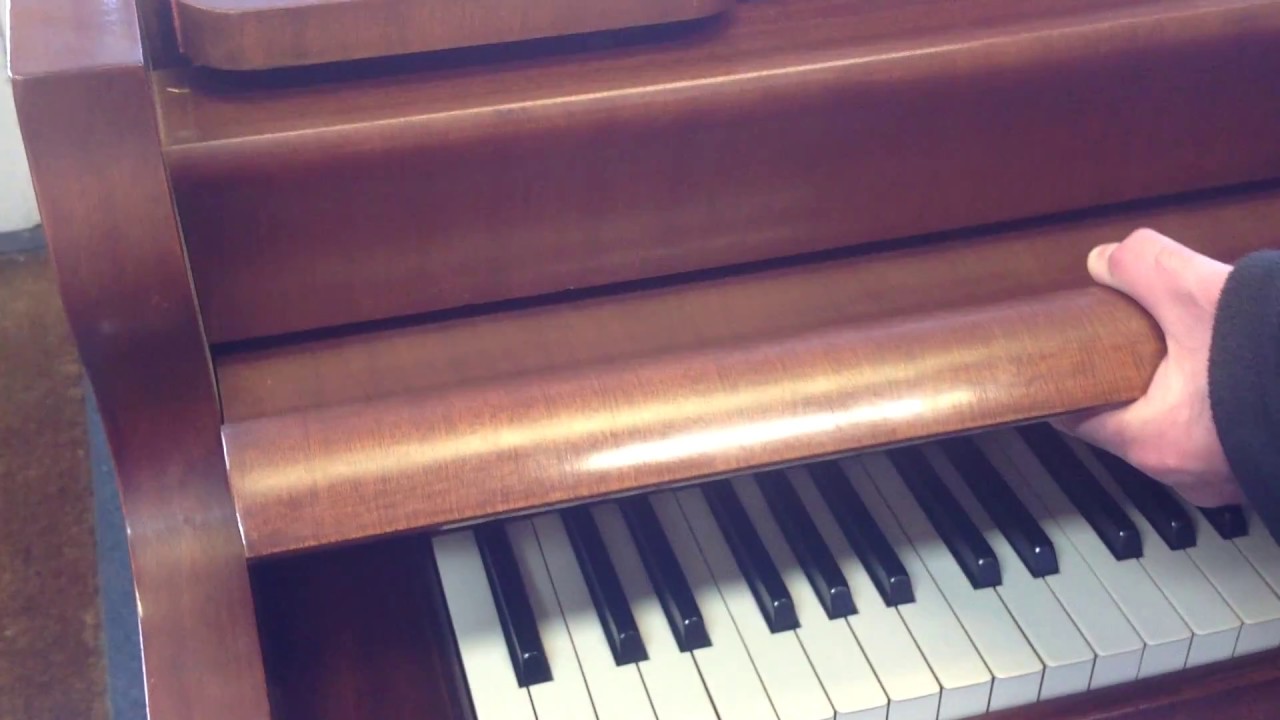
The fallboard is simply the piano’s lid that you open and close.
It may look like just a cover, but it’s actually one of the parts we service most often.
Common issues with older fallboards include loose hinges, stiff sliding rails,
or malfunctioning soft-close mechanisms.
We remove the fallboard for thorough cleaning, polish the rails, and lubricate them.
For fallboards with soft-close systems, we readjust the damping speed
to ensure they close smoothly, quietly, and without pinching fingers.
We also inspect the felt cushioning strip inside the fallboard,
because that loud “thump” you hear when closing the lid
is often just the old felt that has hardened with age.
We replace it entirely with new soft felt—
one of those details you can’t see, but will absolutely feel.
*** Pinblock: The “Bones” of the Entire Piano
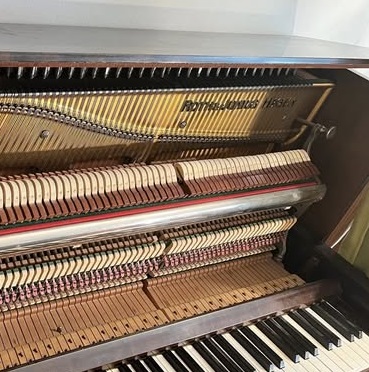
The pinblock is the wooden board that holds the tuning pins.
It’s usually made of several layers of high-density laminated maple.
If it becomes loose or cracked, the entire tuning system loses its stability.
We check the wood layers for any signs of delamination,
then use microscopic probes to test the tightness of each pin hole.
If we find aging or moisture swelling, we perform a “re-hardening” procedure—
injecting eco-friendly resin and heat-curing it
to restore the wood’s strength and density so it can “grip” the tuning pins firmly again.
This process is extremely time-consuming, but we never skip it.
Because the pinblock’s stability determines whether the piano
will remain solid and reliable ten or twenty years down the line.
*** Pressure Bar: Small and Unassuming, Yet the Guardian of Pitch Stability
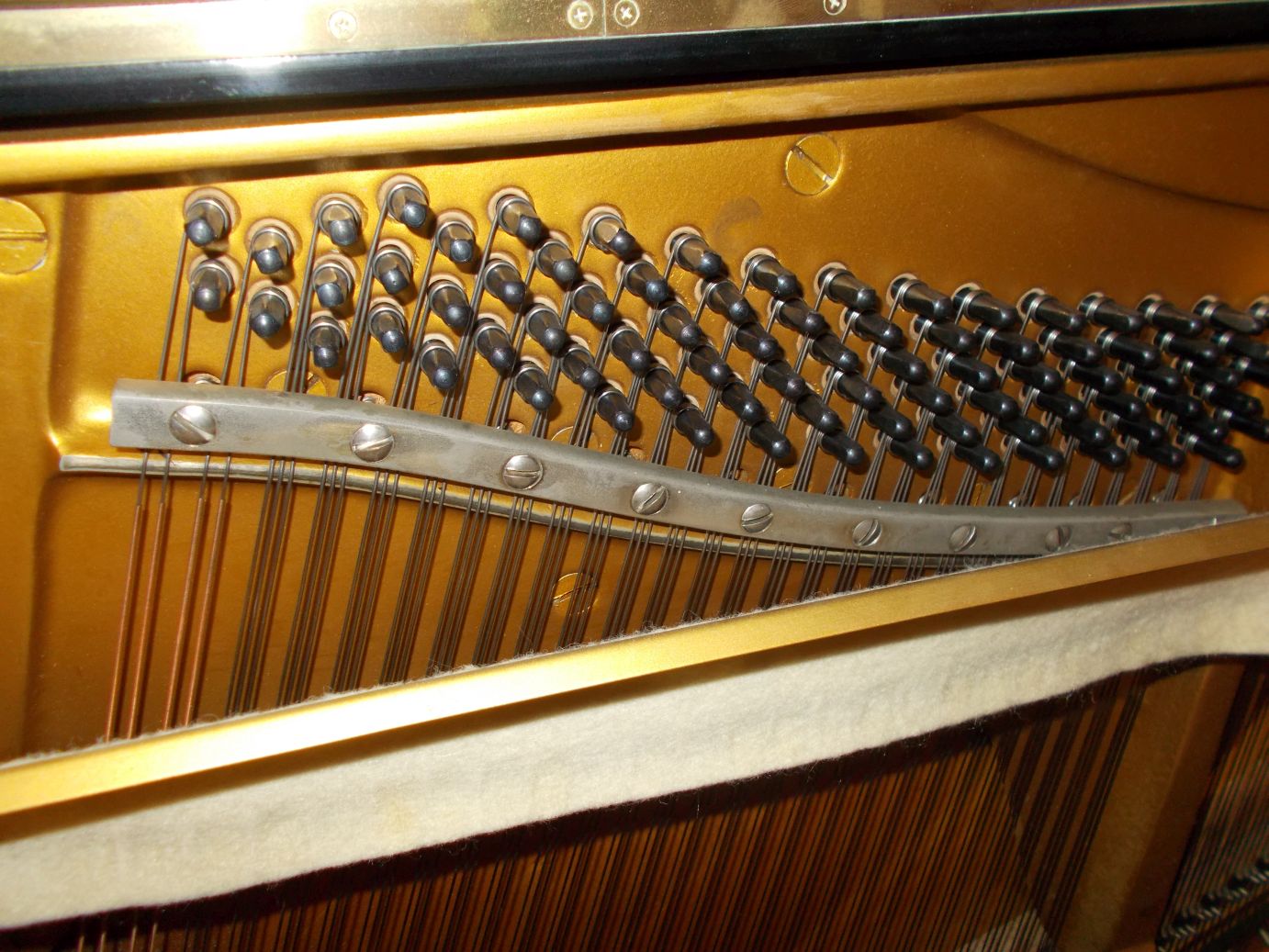
The pressure bar controls the downward pressure of the strings,
ensuring each one stays firmly seated on the bearing point—no floating, no jumping.
If the pressure is uneven, the strings’ resonance becomes unstable.
We use precision gauges to measure the curvature and pressure differences of each string,
then readjust them with micro-screws.
This adjustment often takes hours,
because even a 0.5 mm discrepancy can cause an entire register to drift out of tune.
We’d rather take our time to ensure every piano has a solid foundation for its tone.
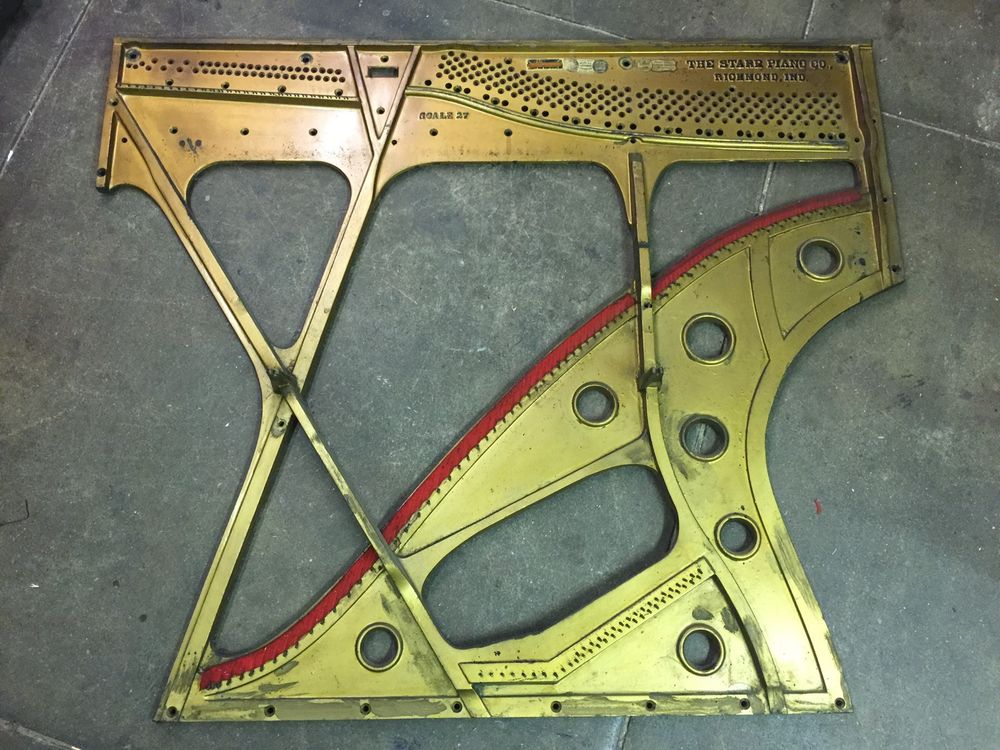
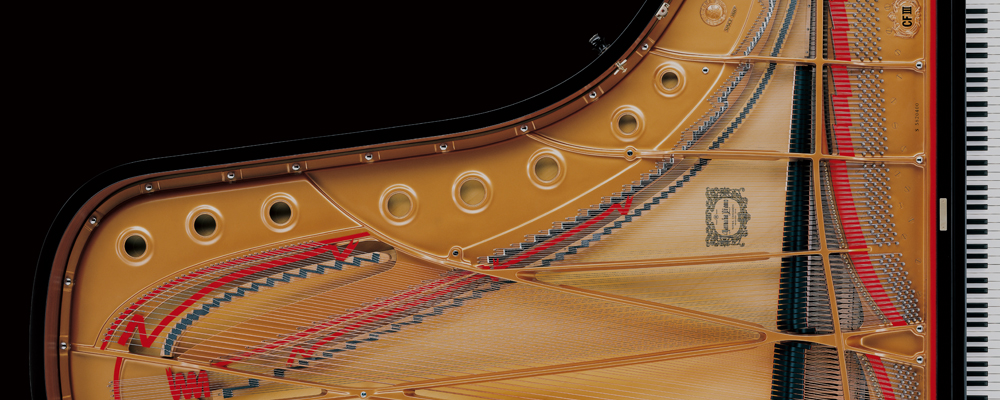
*** Plate (Iron Plate) & Cast Iron Plate: The Giant That Withstands 20 Tons of Tension
Many people don’t realize that the iron plate inside a piano must withstand more than 20 tons of string tension.
Though it appears indestructible, over time it can develop small patches of rust or chipped paint.
We begin by cleaning dust and rust from the plate’s surface, then repair the paint using specialized coatings.
This is not something that can be done with ordinary spray paint—
we use custom-mixed matte anti-corrosion paint that protects the structure
while preserving the original factory texture.
The plate is often engraved with markings, serial numbers, and logos.
We always preserve their original appearance,
because they are essentially the piano’s “ID card.”
Some customers say after seeing the restored plate:
“This piano looks newer than a brand-new one.”
But that sense of “newness” doesn’t come from repainting—
it comes from restoring the instrument’s original spirit.
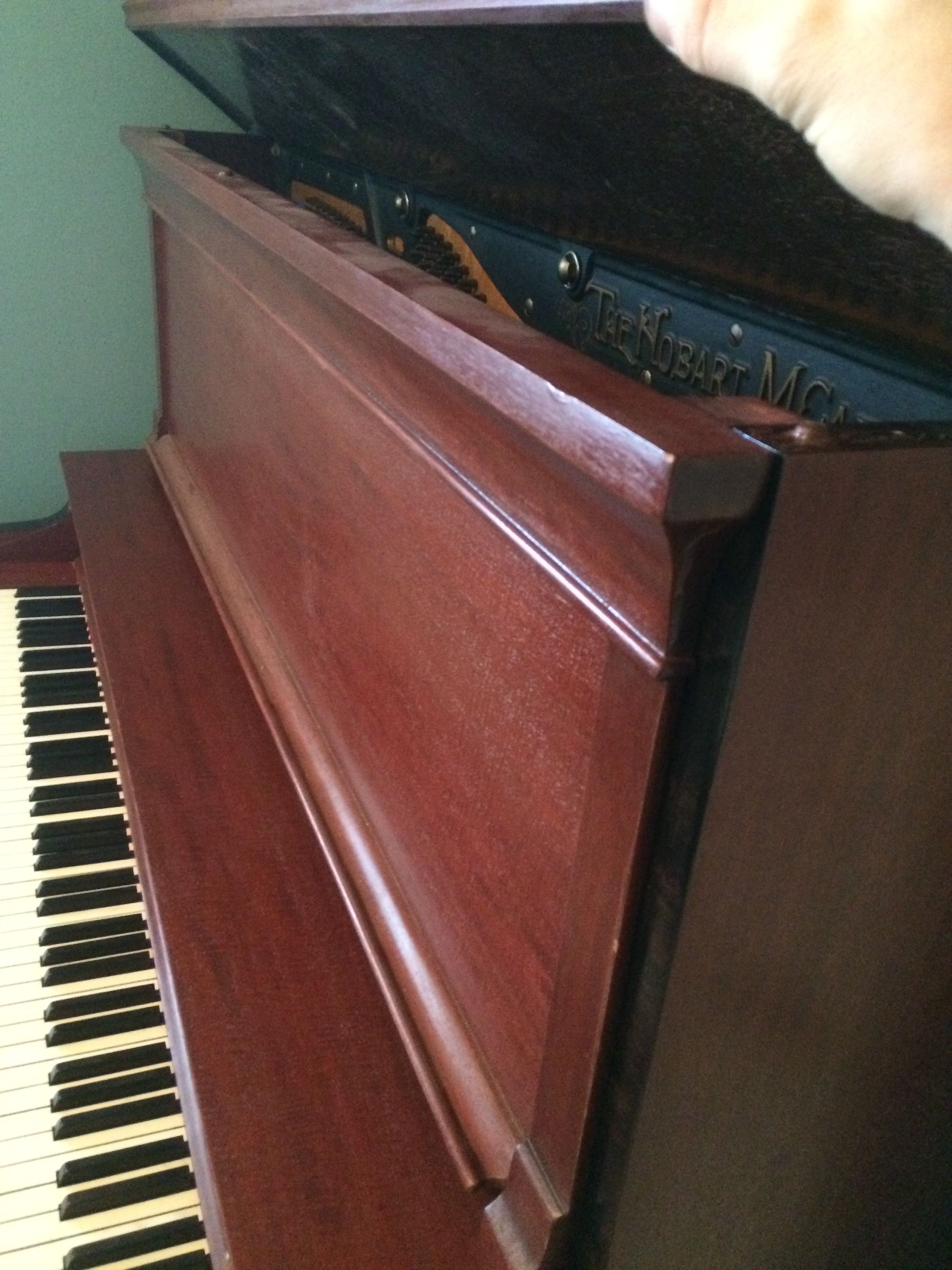
*** Lid & Frame: The First Impression—And One That Must Hold Up to a Second Look
The lid is the large cover on top of the piano,
and the frame is the structural support of the entire instrument.
We thoroughly clean both the inner and outer surfaces of the lid,
and inspect the hinges and support rod for smooth operation.
On older pianos, support rods often loosen or make metallic scratching noises.
We re-oil them, polish them, and adjust their angles.
When you open the lid, it should be stable, quiet, and free of wobble—
that clean “click” you hear is the result of professional maintenance.
The frame is the skeleton of the piano.
We inspect every joint for looseness and reinforce them with professional-grade screws.
For upright pianos especially, we check each back beam by hand, one by one.
A stable structure means a stable sound.
We often say:
“Good tone isn’t tuned into existence—it’s supported into existence.”
*** Hammer Rail: Ensuring Each Hammer Has the Perfect Striking Angle
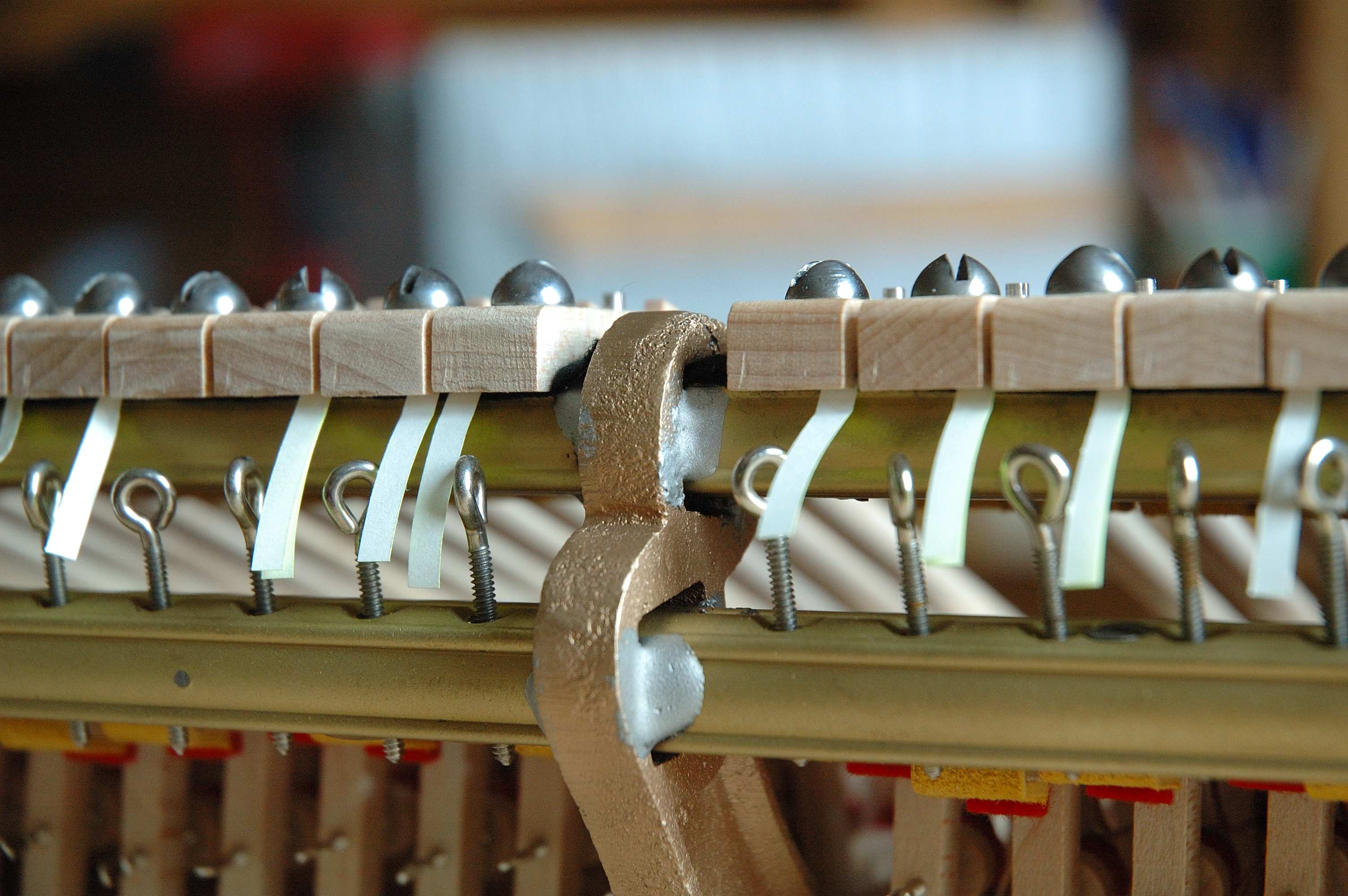
The hammer rail supports and positions the entire hammer system.
If it becomes warped or loose, the hammer strike angle will be off.
We remove the hammer rail, clean the track and mounting points,
and correct any deformation caused by humidity—sometimes through heating,
and sometimes by replacing the rail with a new one of the same specification.
After adjustment, we test the return speed of each hammer,
making sure every strike is clean, smooth, and free of extra noise.
Once this step is done, you’ll feel it when you play—
that sense of “clear separation between keys and solid, precise impact.”
That’s the hammer rail quietly doing its job.
*** Rim (Piano Body Shell): The Resonance Boundary That Gives Sound Its Shape
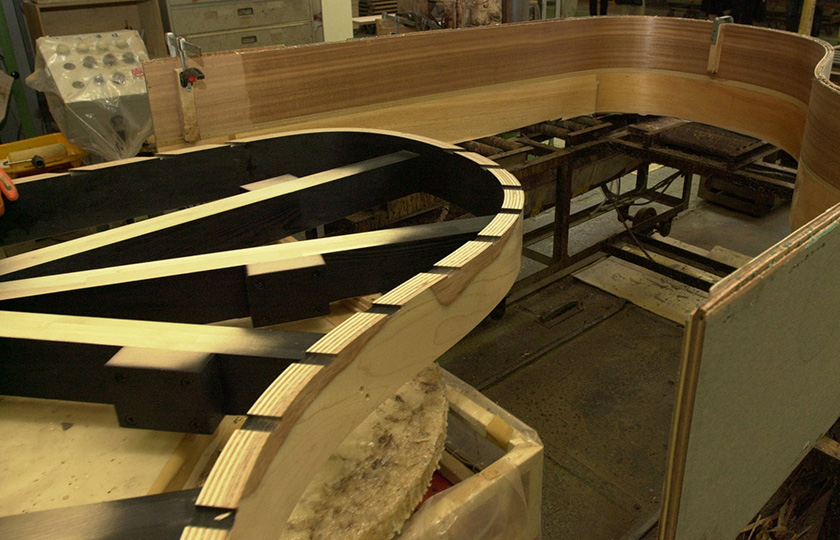
The rim is the outer frame or shell of the piano.
It not only determines the instrument’s visual contours,
but also influences its resonance chamber.
We carefully inspect the rim’s joints for tightness,
then use a light-reflection method to check for subtle warping.
Where cracks appear, we repair them with natural wood pieces,
keeping the wood grain direction consistent.
Finally, we re-wax and polish the entire rim,
restoring its original “warm luster.”
When the restored piano sits under the showroom lights,
its sheen isn’t the sharp brightness of a new instrument,
but the gentle, enduring beauty that only time can shape.
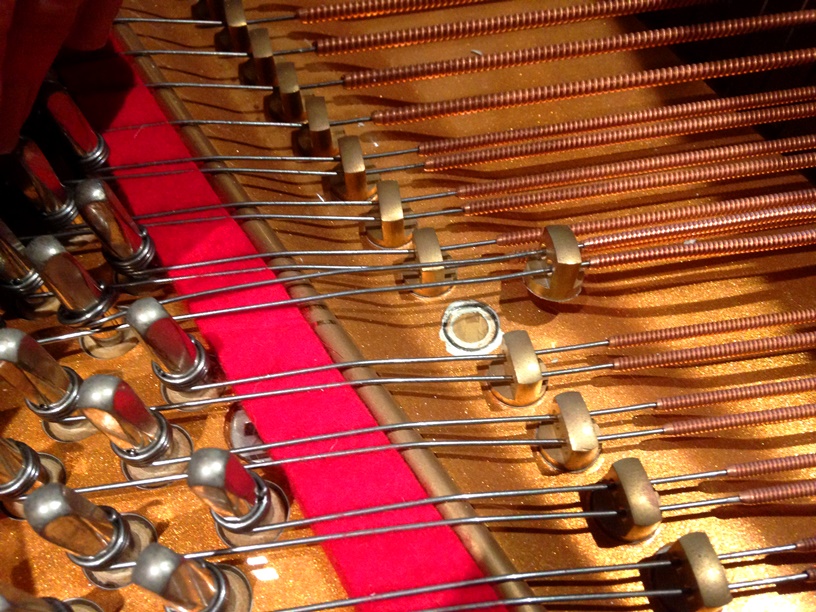
*** Agraffe: The Invisible Guardian of Pitch Stability
The agraffe is the small metal block above the string line.
It fixes each string in its precise position
and determines the effective vibrating length between the string and the bridge.
If the agraffe screws become loose or the surface wears down,
the string angle shifts, affecting both pitch and tone.
We remove and clean each one, then fasten them securely.
For those heavily oxidized, we use ultrasonic cleaning
to restore a smooth surface—reducing friction so the strings vibrate more freely.
Sometimes, a piano’s treble sounds dull simply because a few agraffes are clogged with dust.
These tiny details are things we never overlook.
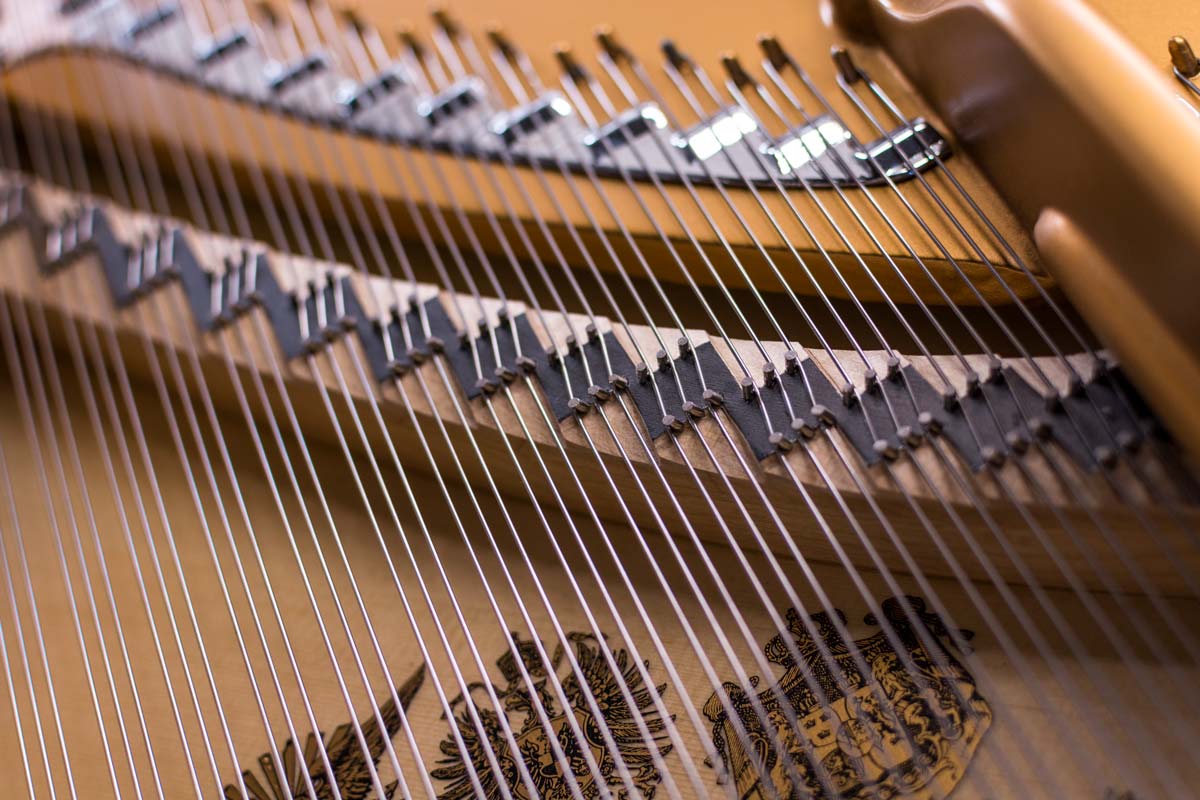
*** Bass Bridge: The Foundation of Deep, Resonant Tone
The bass bridge differs slightly in structure from the treble bridge.
It must handle thicker strings and much greater vibration force.
We carefully inspect the bass bridge’s glued layers and its mounting screws.
If anything here becomes loose or aged, the bass will “collapse,”
losing its depth and resonance.
During restoration, we reinforce or replace sections with high-density hard maple
to maintain a firm, efficient transfer of vibration.
After adjustments, we repeatedly test each bass note’s sustain length and vibration pattern
until the sound becomes full, weighty, clean, and free of unwanted resonance.
Many customers say the first time they play our restored pianos:
“Wow, the bass is so solid—it feels just like a brand-new piano!”
In truth, that stability comes from every fine adjustment and every screw set perfectly in place.
*** Lock Rail: The Hidden Sense of Security Behind the Front Panel
The lock rail is a wooden beam located above the keyboard.
Most people never notice it, yet it supports the entire front frame.
If it becomes loose, the keyboard area will wobble slightly,
and over time this affects the stability of keystrokes.
During restoration, we remove it, tighten all screws,
clean the internal felt padding,
and finish by waxing and polishing to preserve both strength and natural wood texture.
You may never look at it directly, but you’ll definitely feel it when playing— that solid, unshakable sense of stability.
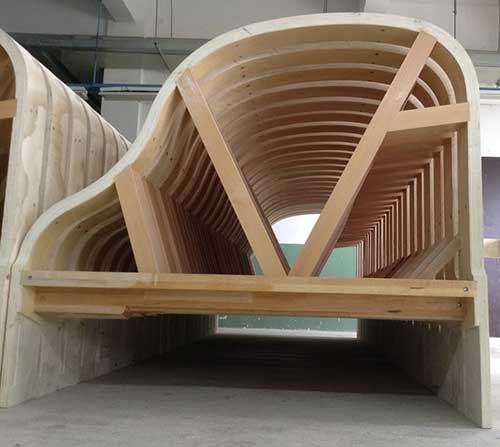
*** Ribs: The “Bones” That Give the Soundboard Its Strength
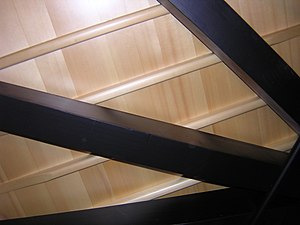
Behind every soundboard are several wooden ribs.
They support the board’s curvature and define its elasticity.
We check each rib to ensure it is tightly bonded with no signs of delamination.
If any rib is loose, we re-glue, clamp, and secure it.
This process is very delicate because the original crown tension must be preserved.
Once restored, the soundboard’s resonance becomes more open and transparent,
and the connection between notes feels more natural.
That is the “deep resonance” that healthy ribs bring back.
*** Beams: The Core of Strength and Structure
Beams are like the spine of the piano—
supporting the entire back structure and connecting the rim and plate.
We inspect each beam’s screws, wood grain orientation, and joints.
Loose areas are reinforced;
any cracks or aging are repaired with matching wood inserts,
then sanded to ensure even energy transmission.
When all beams are stable again,
the low frequencies become more focused and less scattered.
The piano feels more grounded—
a stability you may not hear, but you definitely feel.
*** Hitchpin: The End of the String—But Also the Start of the Sound
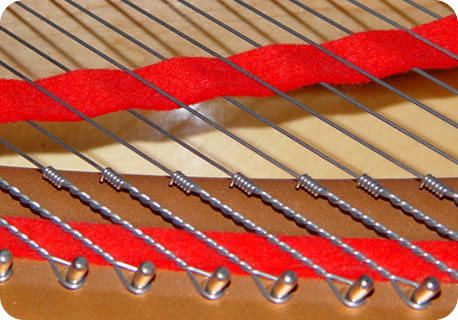
Every string is anchored to a hitchpin.
Its position, angle, and cleanliness all influence how the string vibrates.
We clean the surface of every hitchpin to ensure no oxidation or rust.
Those that are severely aged are replaced with stainless steel,
then we recalibrate the tail-string alignment
so every string has a consistent “starting point.”
After this step, the piano’s resonance becomes cleaner,
sustain becomes more natural,
and when playing chords, the tonal layers become immediately clearer.
*** Top Support: Keeping the Lid Steady and the Sound Focused
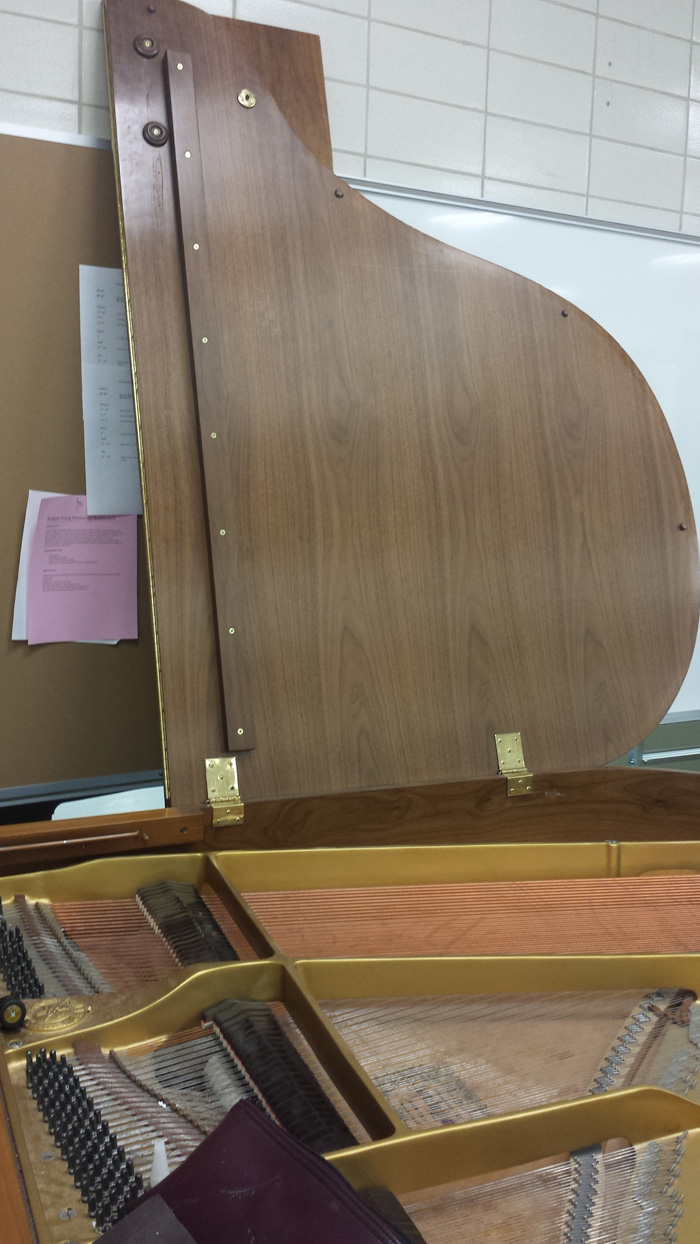
The top support is part of the piano’s upper structure.
It holds the lid and upper frame,
and serves as a key structural connection between the front and back panels.
We check the dowels and mounting points for stability,
reinforcing them whenever necessary.
It seems simple, but if the top support shifts even slightly,
the piano’s resonance chamber changes.
Once repaired, the sound gains noticeably more focus,
and the mid-high frequencies become more penetrating.
We often say this structure is like a “sound wave baffle”—
invisible, yet capable of shaping the entire path of the sound.
*** Upper Panel & Lower Panel: The Refinement of Appearance
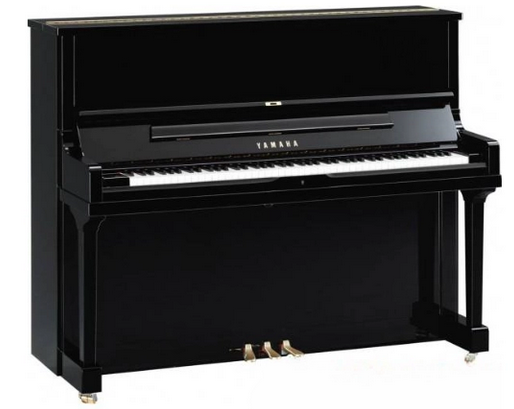
These two panels are the most visible parts of the piano.
We remove them for thorough cleaning, dust removal, and waxing.
For areas with scratches or fading, we repair them using color-matched wood oil,
allowing the tones to blend naturally.
The metal fittings that secure the panels are also polished and re-coated
to prevent aging and oxidation.
When reinstalling, the panels must fit back with silent precision—
no noise, no wobble, no looseness.
Because we believe:
when a piano looks proper and its lines are clean,
the player naturally treats it with more respect.
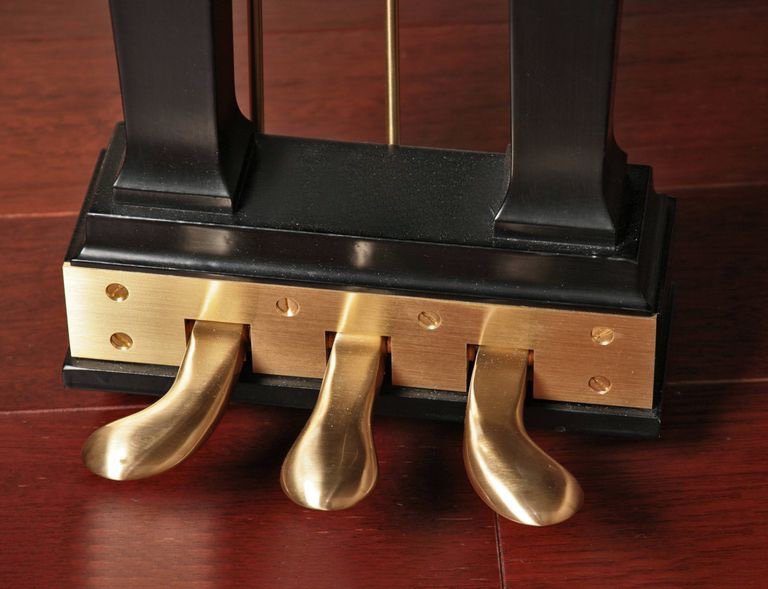
*** Soft Pedal: The Foot That Quietly Changes the World
The soft pedal may seem like it simply lowers the volume,
but in reality, it changes not only loudness, but the color of the sound.
When you press the soft pedal, the entire hammer system shifts slightly,
causing the hammers to strike a different point on the string,
producing a gentler and more delicate tone.
During restoration, we first check whether the linkage rods move smoothly,
making sure nothing sticks or lags.
Then we adjust the pedal travel—
too short and it has no effect; too long and it bottoms out easily.
Finally, we fine-tune the hammer shift distance, usually to a precision of 0.2 mm,
so that every light press transforms the tone just right.
We often say:
“A truly good soft pedal doesn’t make the sound disappear—
it makes details appear.”
That’s the experience we aim to return to every piano.
*** Sustaining Pedal: The Secret Behind Emotional Extension
The sustaining pedal— the rightmost pedal—
is the most frequently used and also the most prone to problems.
Its purpose is to lift all the dampers
so the strings continue resonating after your fingers leave the keys.
We inspect every joint in the pedal mechanism
to ensure nothing is loose or producing unwanted noise.
Next, we adjust the pedal’s travel height and return speed.
An ideal sustain pedal should feel smooth with gentle resistance when pressed,
and should return with a clean “tap,”
neither sluggish nor stiff.
We also test soundboard resonance to ensure all strings sustain evenly,
avoiding situations where “one register suddenly sounds muted.”
Because the sustain pedal is not just a mechanical part—
it is a bridge of emotion.
On a good piano, the moment you press it,
the music should feel like it’s breathing.
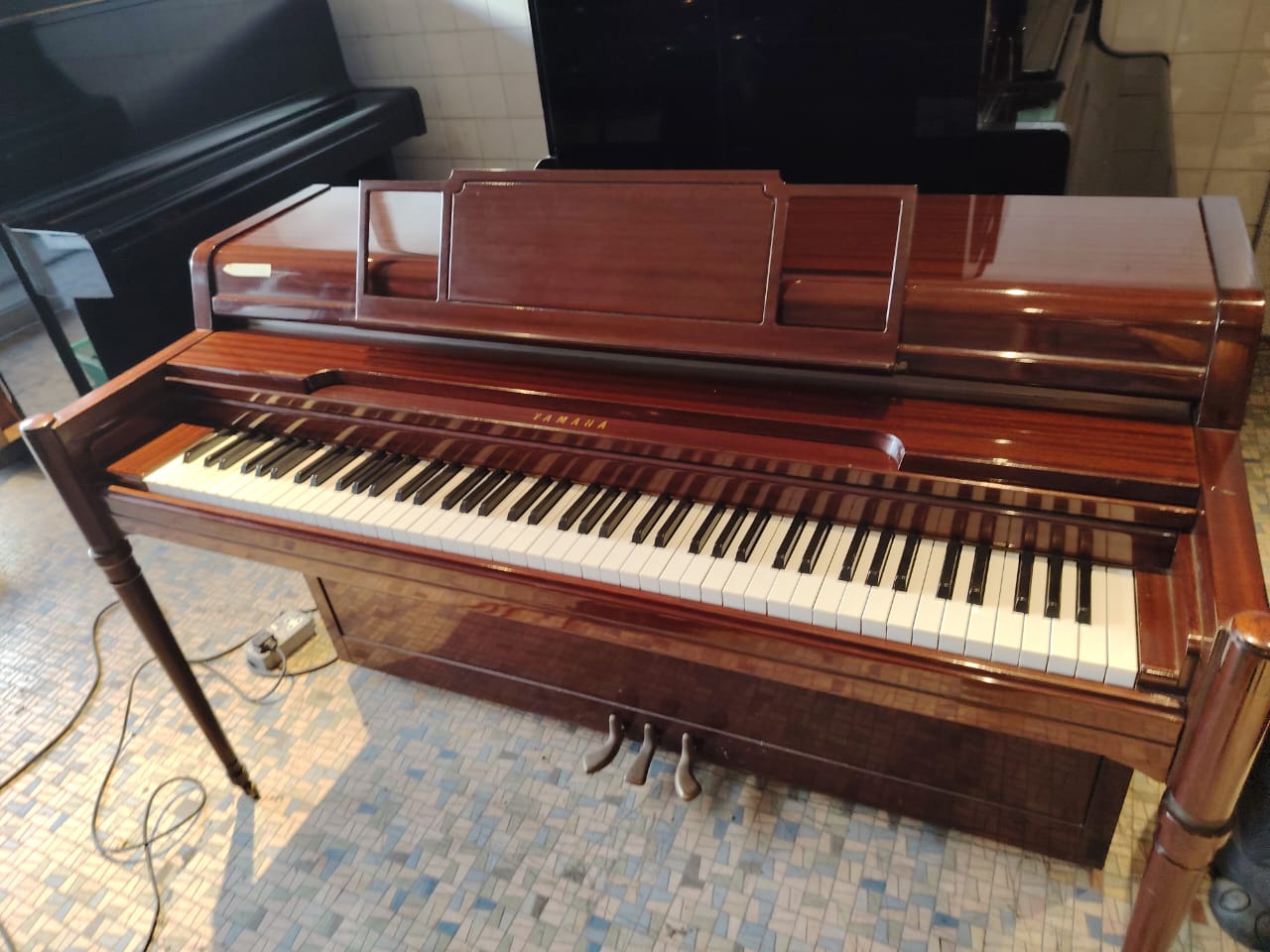
*** Music Stand: Small Detail, Big Warmth
The music stand, the panel that holds your sheet music,
may look like just an accessory,
but its condition often reflects the owner’s daily habits.
On older pianos, the stand’s rotation axis often loosens,
the support latch breaks,
or humidity causes warping so the stand shakes under the music.
We remove it and repair it carefully.
We restore the axis, then adjust the angle and friction—
it should lift smoothly, settle steadily, and feel neither loose nor tight.
If the wood has dulled, we gently sand, wax, and polish it
so it regains its warm, natural luster.
It seems like a small thing,
but when a customer sits down for the first time
and places a score on the stand—
if it moves smoothly and holds firm,
trust forms instantly.
We believe the warmth of details is passed through every touch.
*** Key Block: The Support Under Your Hands, the Foundation of Precision
The key blocks are the supporting wooden pieces on both sides of the keyboard.
They determine the keyboard’s lateral stability and alignment.
If a key block shifts—even by a millimeter—
the balance of the entire keyboard is thrown off.
During restoration, we remove them to inspect screws, guide slots, and felt padding.
On many older pianos, the felt has already compressed,
so we replace it entirely
to ensure the keyboard sits firmly in place with no movement.
We then measure the keyboard’s centerline—
a precise process ensuring perfect symmetry
between each key and the key blocks.
When you play afterward, the support under your fingers feels more natural.
Whether playing legato or staccato,
your touch transfers evenly and comfortably.